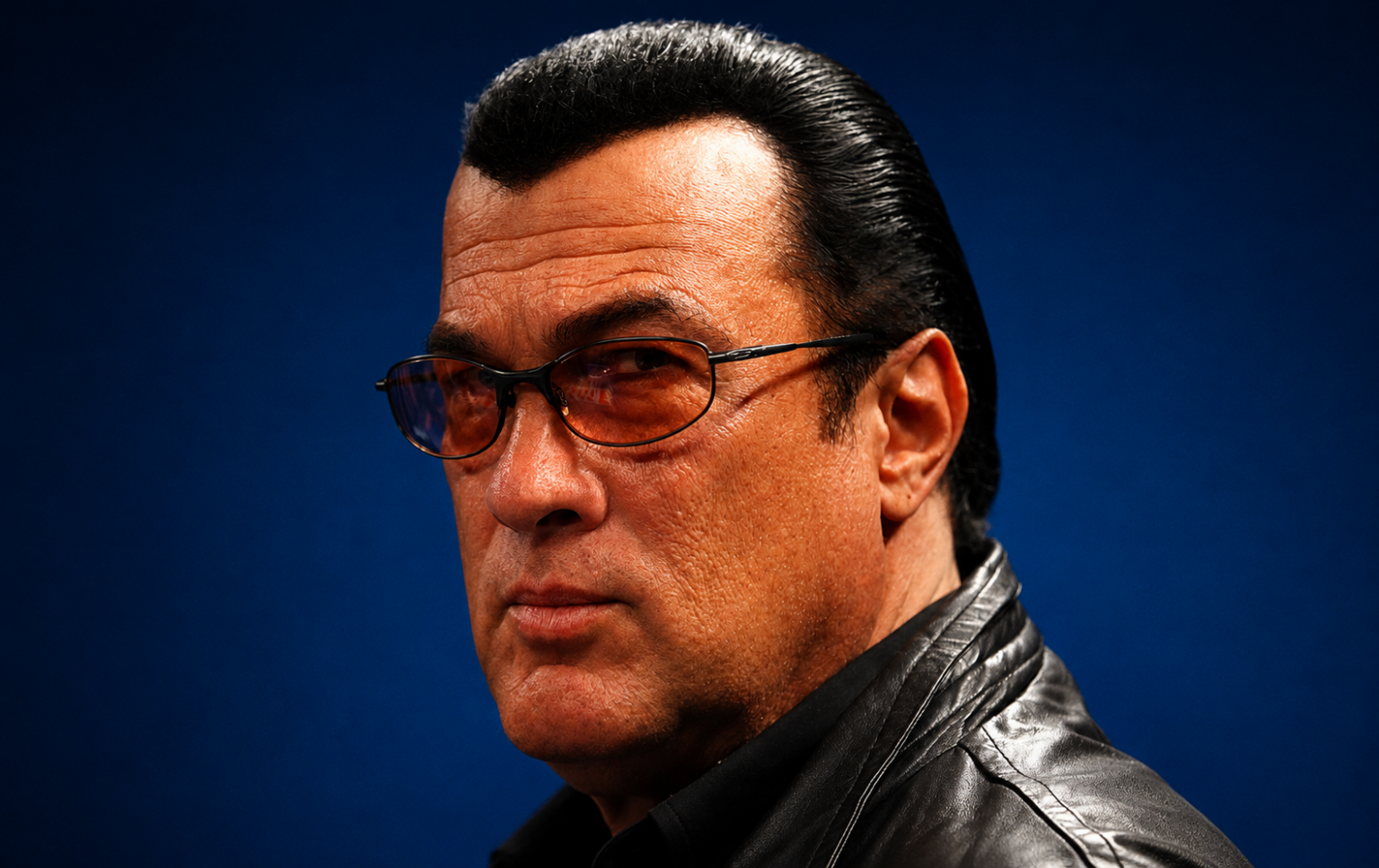
The Steven Seagal net worth question is really two questions. How does a man who once commanded $20 million per film end up worth an estimated $16 million? And where, exactly, did the rest go?
Most net worth pages hand you the dollar figure and a filmography. We’re going to follow the money — the 1990s paydays in today’s dollars, the ventures that quietly drained the account (an energy drink, a blues career, a Russian rifle partnership), and the direct-to-video pivot that reset his earning power. That’s the story the search results only hint at.
Steven Seagal Net Worth at a Glance
- Net worth (2026): ~$16 million (most estimates cluster between $14M and $20M)
- Age: 74, born April 10, 1952, in Lansing, Michigan
- Peak earning years: roughly 1992–1997, when he was a top-tier theatrical action lead
- Income sources: film salaries and producer credits, music, merchandise (energy drink, knives, aftershave), and Russian business ventures
- Notable: Russian citizen since 2016; no official Forbes net worth listing
How Old Is Steven Seagal and What’s His Net Worth Today?
Steven Seagal is 74 years old, born April 10, 1952. His current net worth sits at an estimated $16 million in 2026 — the figure that answers both “how much is Steven Seagal worth” and “how old is Steven Seagal and how much is he worth” in one line.
A caveat worth knowing: there is no official Forbes profile pinning down Seagal’s wealth. The numbers you see on Celebrity Net Worth, Reddit threads, and aggregator sites are estimates built from disclosed film salaries, property sales, and known ventures. We use ~$16 million as the reasonable midpoint. Given his shift to low-budget films and a string of money-losing side businesses, the case for a figure at the lower end of that range is stronger than the case for the higher one.
The Peak: Steven Seagal’s 1990s Earnings
To understand the decline, you have to see how high the peak really was. In the early-to-mid 1990s, Seagal was a genuine box-office draw, and studios paid accordingly. Under Siege (1992) grossed about $156 million worldwide on a modest budget, and that hit turned him into a $10M–$20M-per-picture star for a few golden years.
Here’s what those paydays looked like — and, because no competitor bothers to do this, what they’d be worth in 2026 dollars once you adjust for inflation. This is what people searching “steven seagal net worth 1995” and “net worth peak” actually want to see.
| Film | Year | Reported Salary | Approx. 2026 Dollars |
|---|---|---|---|
| Marked for Death | 1990 | ~$1.5 million | ~$3.6 million |
| Under Siege | 1992 | ~$10 million | ~$22 million |
| On Deadly Ground | 1994 | ~$15 million | ~$31 million |
| The Glimmer Man | 1996 | ~$20 million | ~$39 million |
Read that bottom row again. A single 1996 paycheck, in today’s money, was worth more than twice his entire estimated net worth now. That gap is the whole mystery — and the rest of this article is the answer.
Beyond the Screen: Seagal’s Business Ventures
When the theatrical money was flowing, Seagal spread it into ventures that leaned hard on his tough-guy brand. Most of them didn’t work.
Lightning Bolt: The Energy Drink That Vanished
In 2005, Seagal launched Lightning Bolt, a line of energy drinks sold under the “Steven Seagal’s Lightning Bolt” banner. The pitch was pure Seagal: exotic, vaguely mystical ingredients — think cordyceps mushroom, Asian botanicals, tibetan goji — in flavors like Asian Experience and Cherry Charge. It was positioned as a healthier, martial-arts-inspired alternative to the mainstream cans.
It flopped. The drink struggled for shelf space against Red Bull and Monster, the celebrity-branded beverage market was brutal, and within a few years Lightning Bolt had quietly disappeared from stores. Did Steven Seagal’s energy drink business fail? Yes — comprehensively. It’s the clearest example of brand equity that never converted into a durable revenue stream.
Knives, Aftershave, and Steven Seagal Enterprises
Under the broader Steven Seagal Enterprises umbrella, he also lent his name to merchandise: a line of knives and blades, and even a cologne. These were smaller plays than the energy drink and never became meaningful income. They fit a pattern — licensing the persona rather than building an operating business behind it.
ORSIS Firearms in Russia
The most serious venture came later and further afield. Seagal partnered with ORSIS, a Russian firearms manufacturer, appearing as a brand ambassador and reportedly helping promote the company’s rifles internationally. It’s the one side business tied to real industrial money — and, as we’ll see, to real geopolitical risk.
Steven Seagal’s Music Career: A Surprising Side Income
Here’s the revenue stream almost every net worth article ignores: Steven Seagal is a recording musician, and has been for longer than most fans realize. Back in his Seattle years he played in a band called Thunderbox, and he never fully let go of the guitar.
He released two studio albums — Songs from the Crystal Cave (2004), a genre-hopping record with reggae and world-music leanings, and Mojo Priest (2006), a straight-ahead blues album he toured behind with his band Thunderbox. He owns a collection of vintage and custom guitars and has performed live across the U.S. and abroad.
Did the music move the financial needle? Honestly, no. Critical reception was mixed to poor, sales were modest, and touring a blues act is a labor-of-love business, not a wealth engine. But “does Steven Seagal still make money from music” gets a qualified yes — residuals, licensing, and occasional performances add a trickle. It’s a genuine, if minor, and genuinely oddball, income source.
Why Is Steven Seagal’s Net Worth So Low?
This is the question the top search results dance around without answering. Here’s the direct, causal version.
- The direct-to-video pivot. After the late 1990s, Seagal’s theatrical career collapsed. Films like Ticker, Half Past Dead, and dozens after went straight to DVD and later streaming. DTV budgets are a fraction of studio budgets, and so are the salaries — his quote fell from eight figures to, by many accounts, low-to-mid six figures per film.
- Failed ventures diluted the brand. The energy drink, the merchandise lines — each one spent brand equity without building lasting income. A star’s name is only worth what people will pay for it, and every flop chips away at that.
- Sheer volume at low rates. Seagal has stayed remarkably prolific, but making many cheap movies doesn’t rebuild a fortune the way a few expensive ones did. The math simply doesn’t compare to a $20M theatrical payday.
Put plainly: he didn’t lose his fortune in one dramatic event. It eroded — a lower ceiling on earnings meeting a steady stream of ventures that spent more brand value than they returned.
Real Estate: Where Some of the Peak Fortune Went
Property both stored and released chunks of Seagal’s wealth. He owned a substantial estate in the Scottsdale, Arizona area, which he sold in the early 2020s, and had earlier held ranch property in the Los Olivos, California wine country. Real estate sales like these are part of why the cash net worth figure holds up even as film income shrank — converting hard assets into liquidity is a classic move for a star whose peak earning years are behind him.
Russia, Putin, and Seagal’s Financial Ties
No account of Seagal’s finances in 2026 is complete without the Russia chapter — and, remarkably, almost no competitor connects it to his money.
In 2016, Vladimir Putin personally granted Seagal Russian citizenship, and he was later awarded Russia’s Order of Friendship. Beyond the ORSIS firearms partnership, Seagal aligned himself with Russian business and cultural projects and became a visible pro-Kremlin figure in the West.
That alignment carries financial consequences. Seagal has faced sanctions and travel restrictions from Ukraine and has been a target of Western scrutiny over his Russian ties. Reports in 2025 indicated he stepped back from certain Russian business projects — a sign that the geopolitical environment has become a liability rather than an asset. For a man whose current income depends partly on international ventures, sanctions risk isn’t abstract; it directly caps where and how he can earn.
Steven Seagal Net Worth 2026: The Bottom Line
The Steven Seagal net worth 2026 figure of roughly $16 million is the residue of a fortune that was, at its peak, several times larger in real terms. He earned like an A-lister for about five years, then spent the next twenty-five as a direct-to-video workhorse whose side ventures — an energy drink, merchandise, music, Russian business deals — mostly cost more brand value than they returned. The money didn’t vanish. It got spread thin, and the faucet never opened that wide again.
If you like these follow-the-money breakdowns, see how Henry Cavill built a $50M fortune from Superman and The Witcher, how Brie Larson turned Captain Marvel into her fortune, and — for a very different musician’s money story — how Cat Stevens built and kept his wealth. For another action-era star, our look at Ralph Fiennes’ $50M fortune makes an interesting contrast.
FAQs
How much is Steven Seagal worth today?
Steven Seagal’s net worth is estimated at about $16 million in 2026, with most sources placing him between $14 million and $20 million. There is no official Forbes listing, so these figures are estimates built from disclosed film salaries, property sales, and his various ventures.
What was Steven Seagal’s net worth at his peak?
At his mid-1990s peak, Seagal earned up to $20 million per film — roughly $39 million in 2026 dollars for The Glimmer Man alone. His annual earning power during 1992–1997 dwarfed his current total net worth, which is why the decline is so striking.
Why is Steven Seagal’s net worth so low compared to other 90s action stars?
Three reasons: his career shifted from big theatrical films to low-budget direct-to-video movies after the late 1990s, slashing his salary; several ventures like the Lightning Bolt energy drink failed and drained brand value; and making many cheap films simply doesn’t rebuild wealth the way a few $20 million paydays did.
Did Steven Seagal’s energy drink business fail?
Yes. Lightning Bolt, launched in 2005 with martial-arts-themed ingredients like cordyceps mushroom and flavors such as Asian Experience, couldn’t win shelf space against Red Bull and Monster. It quietly disappeared from stores within a few years and became the clearest example of his brand not converting into lasting income.
Does Steven Seagal still make money from music?
In a small way, yes. Seagal released two blues and world-music albums — Songs from the Crystal Cave (2004) and Mojo Priest (2006) — and still performs occasionally with his band. Sales and reviews were modest, so music is a minor, oddball income stream rather than a real wealth driver.
How did Steven Seagal’s Russian ties affect his finances?
Seagal became a Russian citizen in 2016 and partnered with the firearms maker ORSIS, but his pro-Kremlin alignment brought sanctions and travel restrictions from Ukraine and Western scrutiny. Reports in 2025 said he exited certain Russian business projects, showing the ties have become a financial liability rather than an asset.